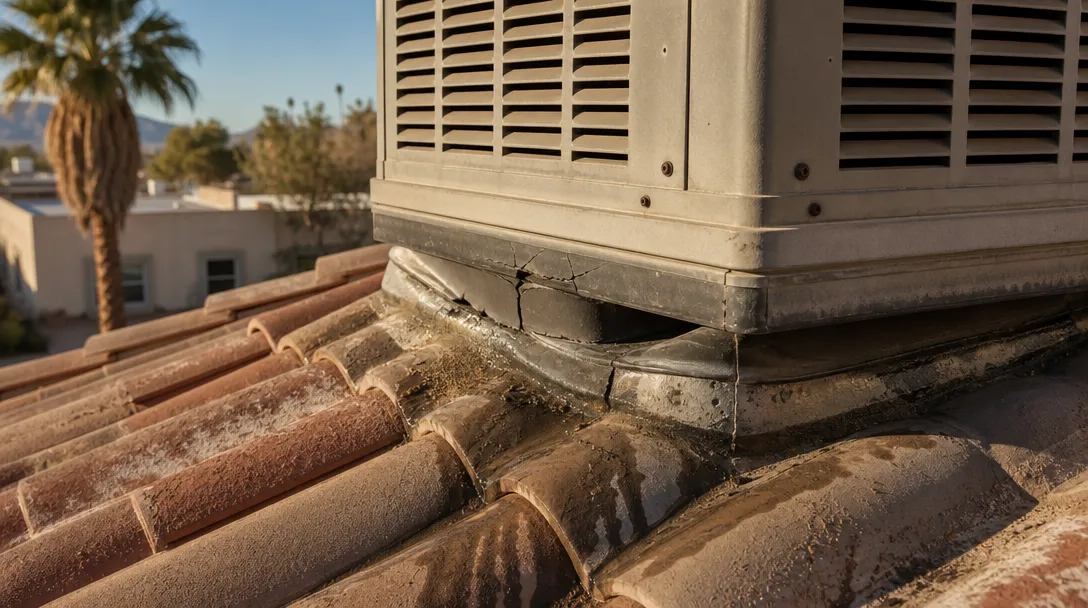
Evaporative cooler leaks on your roof often go unnoticed for months because water bypasses visible shingles or tile and seeps through the penetration point, soaking the decking and attic. One cracked pipe boot can let in enough moisture to cause over $2,500 in structural damage before a ceiling stain ever appears.
- Evaporative cooler penetrations are one of the most overlooked roof leak sources in South Tucson homes.
- Water can saturate your attic for months before a ceiling stain shows up, making early detection critical.
- A professional roof inspection that checks pipe boots, sealant, and attic moisture catches problems when they are still cheap to fix.
- A simple boot replacement costs a few hundred dollars; ignoring it can lead to $6,000+ in structural repairs.
- Pre-monsoon cooler service and annual roof inspections focused on penetrations are the best defense.
What Happens When an Evaporative Cooler Leaks on Your Roof?
When an evaporative cooler leaks on your roof, the water does not pool on the shingles or tiles: it travels straight down through the penetration point where the duct enters the attic, silently saturating the roof deck, insulation, and framing for weeks or months before any interior sign appears. The typical timeline starts with a small crack in the rubber pipe boot or a dried-out sealant bead. This exact pattern played out on a home near Kino Sports Complex in Tucson, where a cracked pipe boot at an old evaporative cooler penetration went unnoticed for a full monsoon season before the ceiling damage revealed how far the water had traveled. During every cooling cycle, a trickle of water escapes, dampening the wood decking and insulation. Over time, that hidden moisture can foster mold growth long before you see a stain on your ceiling. The U.S. EPA identifies slow, hidden moisture intrusion from roof and mechanical leaks as a primary cause of indoor mold and structural damage. Meanwhile, InterNACHI inspection standards confirm that roof penetrations are the most common leak source, not the field of roofing material itself. That is why our roof inspection always includes a thorough attic examination, because interior checks are just as important as rooftop visual surveys.
How Swamp Cooler Penetrations Create the Perfect Leak Path
Every rooftop evaporative cooler relies on a large duct penetration through the roof. That penetration is sealed with a rubber or neoprene pipe boot, a metal flashing, and a bead of exterior sealant. In the Sonoran Desert, these components take a beating. Intense UV radiation breaks down the rubber boot, causing it to crack and lose its grip on the duct. Thermal cycling, where daytime temperatures soar and nights cool off, expands and contracts the metal flashing until the sealant fails. Even when the cooler itself is not actively malfunctioning, those degraded seals let monsoon rainwater or cooler condensation seep into the attic.
The Arizona Cooperative Extension explains that evaporative cooler failures often involve float valve problems, pan overflow, or clogged drain lines. When the float valve sticks, water overflows the cooler pan and runs directly down the duct penetration, accelerating the leak. FEMA’s technical fact sheet on roof leaks reinforces that penetrations and flashing are the primary pathways for water entry. In short, the cooler penetration is a ready-made leak path that only needs a small seal failure to start causing damage.
Why South Tucson Roofs Are Especially Vulnerable to Evaporative Cooler Leaks
South Tucson homes face a perfect storm of risk factors: older construction, flat or low-slope roof designs, and one of the most punishing UV environments in the country. Many homes in neighborhoods south of downtown were built decades ago, before modern high-durability pipe boots and advanced sealants existed. The original materials have now exceeded their service life. Add in Tucson’s monsoon-driven thermal cycling, where a roof surface can swing 50 degrees in a single day, and those aging seals fail even faster.
Flat and low-slope roofs, which are common on mid-century South Tucson homes, are especially unforgiving. Water that enters a penetration has nowhere to drain and instead pools inside the attic or saturates the decking. The EPA warns that in hot climates, hidden moisture combined with attic heat creates ideal conditions for mold growth. Our roof inspection service follows a two-season calendar specifically because Tucson’s climate demands pre- and post-monsoon checks. Without that rhythm, a silent evaporative cooler leak can go unnoticed through an entire summer, compounding the damage.
The Roof Surface Looks Fine, but the Attic Tells a Different Story
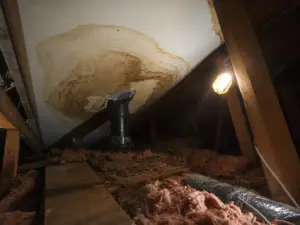
Even when shingles or tiles appear intact from the ground, a leaking evaporative cooler penetration will leave clear evidence in the attic: water stains on the decking, damp insulation, rusted ductwork, or a musty odor that signals moisture has been present for months. Homeowners often assume that if the roof surface passes a quick visual check, everything is fine. That assumption is exactly what allows penetration leaks to become expensive repairs.
During a professional roof inspection, we access the attic and look for exactly these signs. InterNACHI’s inspection standards emphasize that attic moisture evaluation is a critical component of any thorough roof inspection, because penetration leaks rarely show themselves from the outside first. The EPA confirms that moisture can accumulate for months before a ceiling stain appears. By the time you see a brown ring on your ceiling, the decking may already need replacement and mold remediation may be necessary.
What a Professional Roof Inspection Actually Checks Around Your Cooler
A professional roof inspection focused on evaporative cooler penetrations examines the pipe boot for cracks, the sealant for gaps, the flashing for rust or separation, the cooler pan and float valve for leaks, and the attic for any sign of moisture intrusion. This is not a generic “roof is old” walk-around. It is a targeted inspection of the specific failure points that cause the most damage in Tucson homes.
Our inspection includes a detailed written report with photos, so you can see exactly what condition your cooler penetration is in. We check the rubber boot for UV degradation, look for dried or missing sealant beads, verify that the metal flashing is still watertight, and test the cooler’s float valve and overflow drain. InterNACHI guidance lists these same penetration components as essential inspection points. When you receive a written report with photos, you have a clear record of what needs attention now, before a small seal crack turns into a major leak.
The Cost of Ignoring a Small Boot Failure
The difference between catching a boot failure early and waiting for a ceiling stain is measured in thousands of dollars. The table below shows how the repair scope expands as water travels deeper into your home.
| Leak Stage | What’s Damaged | Typical Repair Scope | Approximate Cost Range |
|---|---|---|---|
| Early seal crack | Pipe boot only | Boot replacement, reseal | $200, $400 |
| Water reaching decking | Boot + roof deck | Deck repair, new boot, seal | $800, $2,000 |
| Ceiling stain visible | Boot, deck, insulation, drywall | Structural repair, mold check, cooler service | $2,500, $6,000+ |
These ranges reflect typical Southern Arizona pricing, but every roof is different. The best way to get an accurate number is a free estimate from a licensed contractor who can inspect the penetration firsthand. Our same-day roof repair service means that once we identify the problem, we can often fix it before it gets worse, and we provide a written warranty on the work.
How to Spot the Early Warning Signs Before a Ceiling Stain Appears
You can spot an evaporative cooler leak months before a ceiling stain appears by checking for rust on the cooler cabinet, peeling paint near the ceiling register, a musty smell when the cooler runs, or damp insulation in the attic. These signs appear gradually and are easy to overlook, but they are reliable indicators that moisture is already getting into places it should not be.
Rust on the cooler cabinet often means water has been overflowing the pan, which then runs down the duct penetration. Peeling paint or bubbling drywall near the ceiling register suggests moisture is wicking through the duct opening. A musty odor when the cooler kicks on is a strong signal that the insulation or duct lining is damp and possibly growing mold. The EPA identifies these moisture indicators as early warning signs of a larger moisture problem. If you notice any of them, do not wait for a stain: have the penetration inspected.
Keeping Your Cooler and Roof Working Together: Maintenance Tips
The best defense against evaporative cooler roof damage is a simple, seasonal routine. Before monsoon season, have your cooler serviced: a technician should check the float valve, clear the overflow drain, and make sure the pan is not rusted through. At the same time, schedule a roof inspection that specifically looks at the pipe boot and sealant around the penetration. The Arizona Cooperative Extension recommends regular cooler maintenance to prevent water damage, and our experience in Tucson confirms that combining cooler service with a roof check catches problems at the intersection of the two systems.
We recommend a two-visit maintenance schedule: one in late spring before the cooling season ramps up, and one in early fall after monsoon season ends. Our two-visit maintenance schedule is designed around Tucson’s unique climate, where summer storms and winter winds each create different stressors on roof penetrations. Replacing the pipe boot and sealant every two to three years is a small investment that prevents the $2,500+ repair scenario. If your cooler is older or your roof is flat, consider upgrading to a high-UV-resistant silicone boot and a modern elastomeric sealant that can handle Tucson’s temperature swings.
Frequently asked questions
How much does it cost to replace a swamp cooler on a roof?
A full rooftop swamp cooler replacement typically costs between $1,500 and $3,500, depending on the unit size, roof accessibility, and whether any decking or ductwork repairs are needed. If the roof penetration has existing water damage, the total project can exceed $4,000. Always get a detailed estimate that separates the cooler replacement from any necessary roof repairs.
Is it normal for an evaporative cooler to leak water?
Some water discharge is normal: evaporative coolers intentionally bleed off a small amount of water to prevent mineral buildup, and they release moisture-laden air. However, continuous dripping, water pooling on the roof, or water stains on the ceiling are not normal and indicate a problem with the float valve, pan, drain line, or the roof penetration seal.
What is the most common cause of roof leaks in Tucson?
In Tucson, the most common cause of roof leaks is not damaged shingles or tiles but failed sealant and flashing around roof penetrations, including vent pipes, HVAC units, and evaporative cooler ducts. Intense UV radiation and thermal cycling crack these seals long before the roofing material itself fails.
Can a swamp cooler leak cause mold in the attic?
Yes. When water from a leaking swamp cooler saturates attic insulation, decking, or ductwork, it creates the warm, damp conditions mold needs to grow. The EPA identifies hidden moisture from roof and mechanical leaks as a leading cause of indoor mold problems. Mold can begin growing within 24 to 48 hours of a leak, and by the time you smell it, remediation may already be necessary.
How often should I have my roof inspected if I have a rooftop evaporative cooler?
If you have a rooftop evaporative cooler, you should have your roof inspected at least twice a year: once in late spring before the cooling season begins, and once in early fall after monsoon season ends. This two-visit schedule catches seal and boot failures before they cause hidden water damage, and it aligns with the cooler’s own seasonal maintenance needs.